The material comes before the project
Geological origin
The sandstones of Muggia are a sedimentary rock dating from the Lutetian (lower Eocene, roughly 50 million years ago): sand derived from the erosion of volcanic rock, bound by siliceous material, which makes it entirely insoluble in water.
The dominant colour is a deep turquoise blue, interleaved with wide yellow-reddish areas caused by iron oxidation in the matrix — the source of the material's warm, pastel tones.
It is an extremely hard and abrasive stone, particularly suited to outdoor use: it never becomes polished through wear, and so stays slip-resistant for its whole service life. It is valued in bioclimatic architecture for helping regulate temperature and humidity.
Where it comes from — the quarry at Muggia, province of Trieste
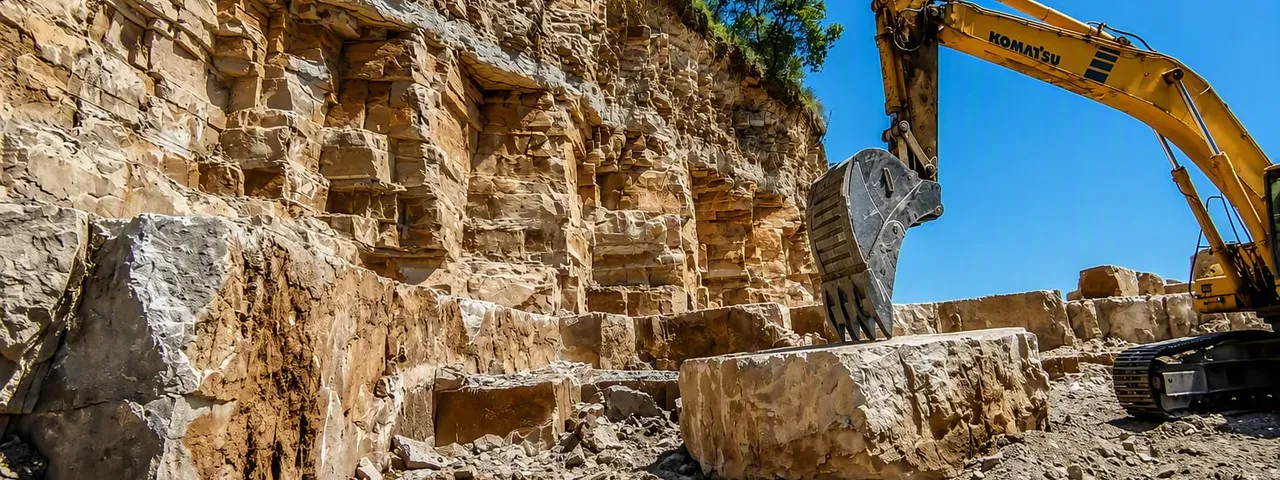
The quarry is at Muggia, in the Noghere area, in the province ofTrieste — the far eastern edge of Friuli-Venezia Giulia, minutes from the Slovenian border. It is the same flysch that much of Trieste is built on: Muggia sandstone and the city's historic building stone are, geologically, the same material.
The supply chain is short: the stone is quarried, worked and delivered within the same area. For a project in the province of Trieste, in Gorizia or Udine, or across the nearby border, that means less transport and one point of contact from block to laying.
The local references are real projects: Piazza della Borsa, Viale XX Settembre and Piazza Hortis in Trieste, Piazza Marconi and the basilica of Muggia Vecchia in Muggia. Outside the region, the same sandstone is at the Basilica of Aquileia and the Rialto Bridge.
For those who want to know moreWhat you can see in the quarry face
The rock of Muggia is part of the flysch, the formation on which much of the city of Trieste is built. A flysch is not one single stone: it is a rhythmic alternation of sandstones and marls — beds of cemented sand and finer, clayey beds, stacked one on top of another for hundreds of metres.
It formed between 50 and 40 million years ago, in the Eocene, on the floor of adeep marine basin. The mechanism is called a turbidity current: sand and mud that had built up on the shelf collapsed down the submarine slope and ran towards the sea floor. As the current lost energy it dropped the coarse material first — the sand, which would become sandstone — and above it, slowly, the finer mud, which would become marl.
Every bed of sandstone visible in the face corresponds to a single collapse, one after another through geological time. That is why the quarry has its striped look: the bedding is not decorative, it is the calendar of those submarine landslides.
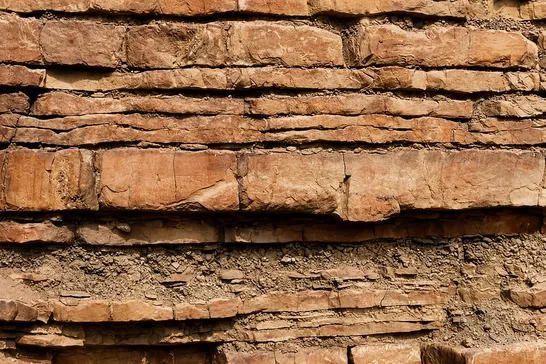
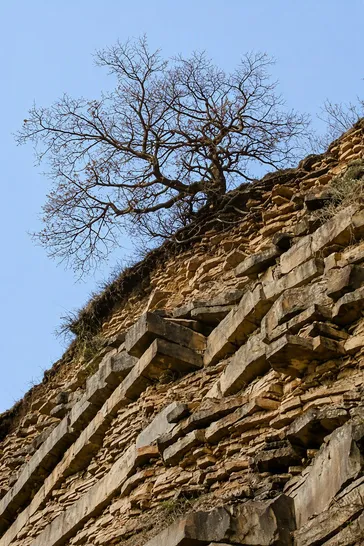
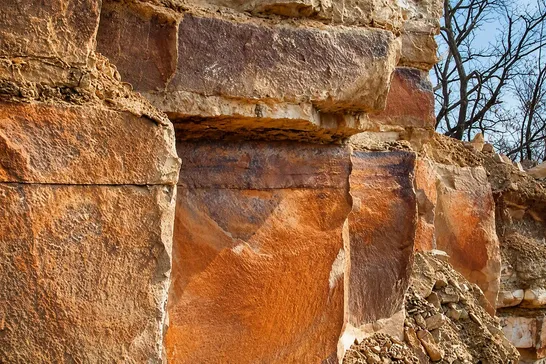
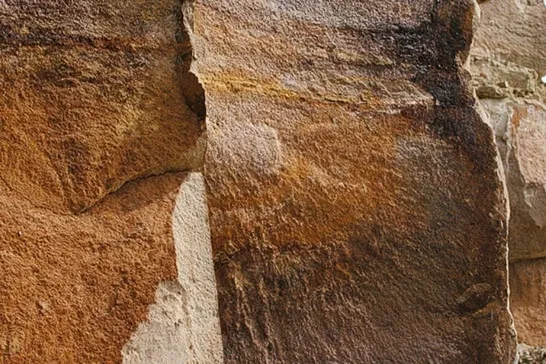
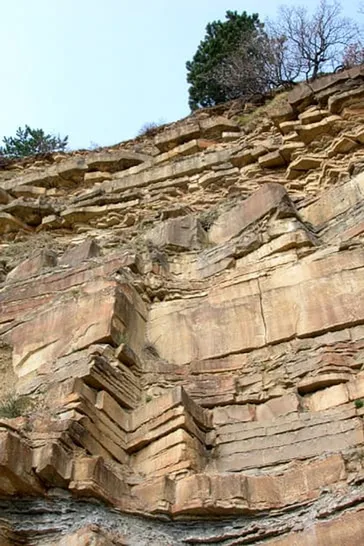
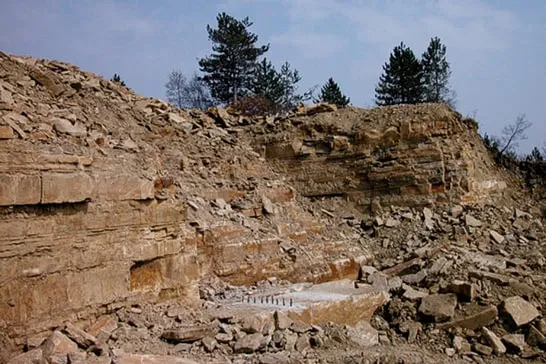
General geological framing of the flysch of the Trieste area. A specific petrographic characterisation of the Renice quarry bank should be requested from the company.
CE marking — laboratory values
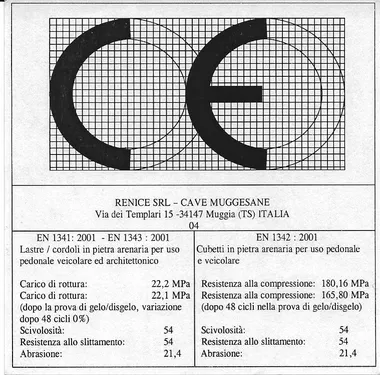
Masegno di Muggia carries CE marking under EN 1341, EN 1342 and EN 1343:2001.
| Standard | EN 1341:2001 / EN 1343:2001 — slabs and kerbs for pedestrian, vehicular and architectural use |
|---|---|
| Breaking load | 22.2 MPa |
| Breaking load after freeze/thaw | 22.1 MPa (0% variation after 48 cycles) |
| Slipperiness | 54 |
| Skid resistance | 54 |
| Abrasion | 21.4 |
| Standard | EN 1342:2001 — setts for pedestrian and vehicular use |
|---|---|
| Compressive strength | 180.16 MPa |
| After freeze/thaw (48 cycles) | 165.80 MPa |
| Slipperiness | 54 |
| Skid resistance | 54 |
| Abrasion | 21.4 |