Sandstone for the restoration of historic fabric
The stone much of Trieste and Muggia is built from, quarried and worked today in the same area. On a historic building the first criterion is compatibility with the original.
The same material, from the same quarry
The flysch of Trieste — the rhythmic alternation of sandstones and marls described on the The Sandstone page — is the formation much of the city is built on, and the source of much of its historic building stone. Muggia sandstone is that stone. In a restoration, using the same material as the original means compatibility: the same behaviour with water and frost, the same thermal movement, the same way of ageing — colour, grain and patina stay consistent with what is already there.
It is a stone that is insoluble in water and never forms a polished surface through wear: it stays slip-resistant for its whole service life, which matters on steps, churchyards and monumental paving walked every day.
The CE marking laboratory values (EN 1341 / 1342 / 1343:2001) say it in numbers:0% variation in breaking load after 48 freeze/thaw cycles. The full table is on thematerial page.
The continuity is not a marketing line: the Romans quarried and worked this sandstone for the roads of Aquileia and for the Theatre of Tergeste, and it is documented in Trieste's building from the seventeenth to the nineteenth century — down to Habsburg-era exports to Vienna. The full story is in About.
Where it has already been used
Projects on historic buildings and monuments carried out with sandstone from the Muggia quarries. The full record of each is in Projects.
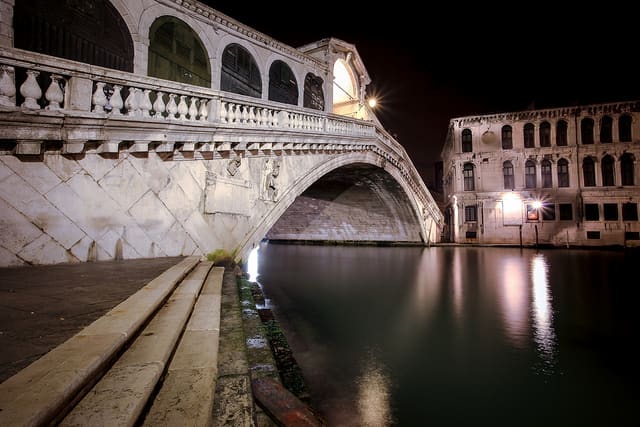 Paving
Ponte di Rialto
Venezia
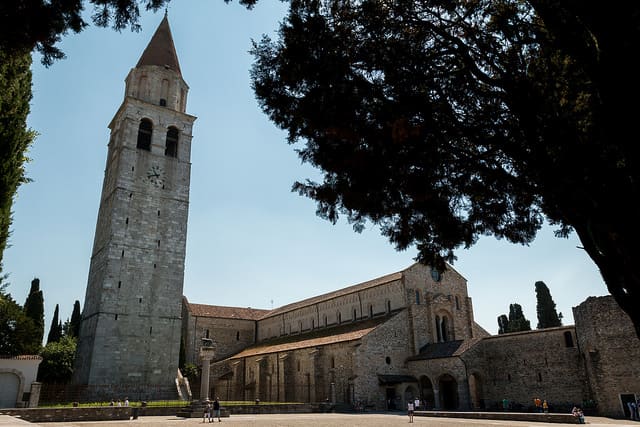 Paving
Basilica di Aquileia
Aquileia (UD) — Patrimonio UNESCO
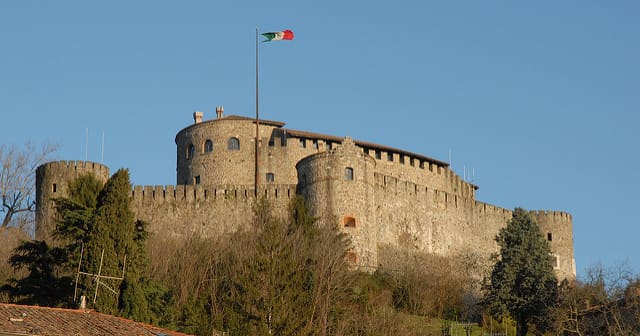 Restoration
Castello di San Giusto
Trieste
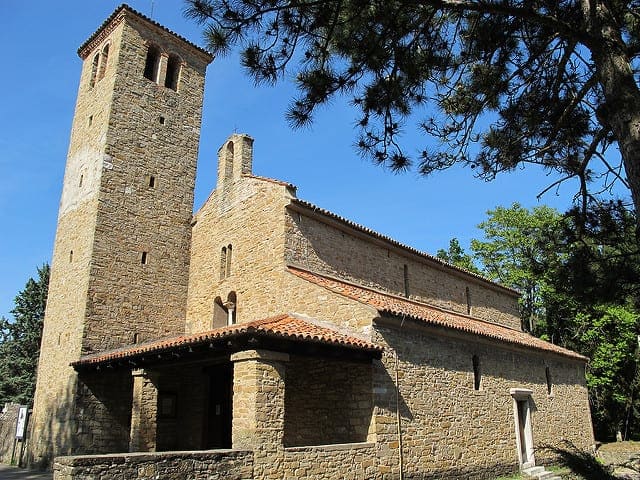 Restoration
Basilica di Muggia Vecchia
Muggia (TS)
Some technical details of the individual projects (year, area worked, laying method) are stillto be confirmed with the client: where they are not verified, the records say so. The best-documented reference is the Rialto Bridge, with figures taken from the reporting of Il Piccolo.
How we work on a restoration project
Samples. On request we prepare samples of the stone with the intended finishes, for direct comparison with the existing fabric and for the documentation to be submitted to the heritage authority (Soprintendenza).
Technical documentation. CE marking and the laboratory value sheets — the same ones on The Sandstone page — to support the authorisation process.
Stonework. From hand-splitting, which follows the natural bedding planes rather than imposing a geometry, to sawing for slabs of controlled thickness. Special pieces — thresholds, treads and risers, jambs, copings, capitals — are made to the project drawing, not from a catalogue.
A restoration project coming up?
Tell us about the building and what you need: we start with the samples.
Request a quote