Two thousand years of quarrying
From the Romans to today
Quarrying sandstone around Muggia is not a recent activity. The ancient Istrians were the first to cut the stone, and the Romans recognised its quality early, using it in the Roman Theatre of Tergeste (today's Trieste) and in the roads of Aquileia.
Under Venetian rule quarrying multiplied — more than a hundred active quarries between the 17th and 19th centuries. Under the Habsburg Empire production grew further, reaching as far as Vienna. The peak came in the 1920s and 1930s with the Gorlato quarries at Renice.
After the Second World War, political complications and competition from brick and concrete closed the quarries by the end of the 1950s. They reopened in the early 1990s, at Renice, using modern splitting and sawing techniques.
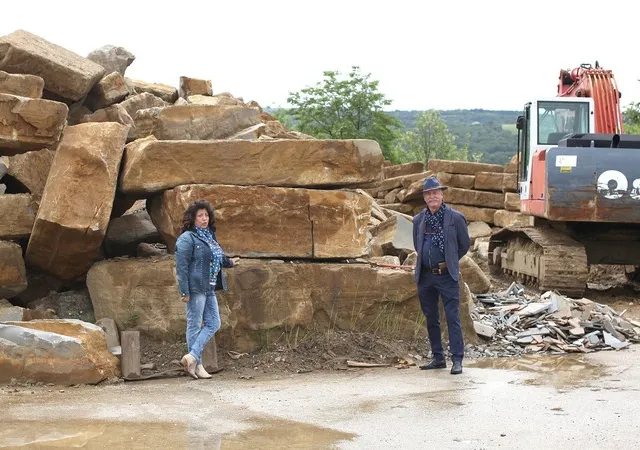
Today the quarry is in the Noghere area of Muggia, run by Dario Macor, owner of Renice s.r.l. Stone from here has paved around 80 Italian squares, from Mestre to Marano, plus work in Slovenia — including the quay of Koper's port. For extracting and working Muggia stone, the company received the Fedeltà al Lavoro e Progresso Economico award from the Trieste Chamber of Commerce.
Sources: Il Piccolo, «Il ponte di Rialto torna a splendere con l'arenaria delle cave di Muggia», 11 August 2016; Il Piccolo, «Progresso economico, premiato Dario Macor».
“The reopening of the quarry at Renice, using new splitting and sawing techniques, allows stone production to resume in the Muggia area — an activity with more than two thousand years of history.”
Two thousand years
The quarry, era by era
Before the Romans
Antiquity
The Histri are the first to cut stone on these hills.
Roman era
Tergeste and Aquileia
The Romans recognise its quality: they use it in the theatre of Tergeste — today’s Trieste — and in the roads of Aquileia.
Venetian rule
17th–19th century
Quarrying multiplies: more than a hundred active quarries in the Muggia area.
Habsburg Empire
19th century
Production grows further and the stone reaches as far as Vienna.
1920s–1930s
The peak
The Gorlato quarries, at Renice, bring the activity to its historic high.
Late 1950s
The closure
The post-war years and competition from brick and concrete stop every quarry.
Early 1990s
The reopening
The quarries reopen at Renice, with modern splitting and sawing techniques.
2016–2017
Rialto Bridge
Around 200 m² of Muggia sandstone for the restoration of Venice’s most famous bridge.
→
What that means in practice
Direct supply chain
From the quarry face to the finished slab, with no middlemen on the material.
Modern technique, old craft
Split stonework and industrial sawing on stone quarried here for two millennia.
Certified material
Masegno di Muggia carries CE marking — see the technical data.